Showing posts with label Hawaii. Show all posts

Tuesday, November 10, 2009

The Wall

"The Wall' - what do these two words bring to your mind. The Berlin Wall or The Great Wall? Pink Floyd? Back against the wall? I have a pal whose nickname was TheWall - nothing gets past him.

That is the purpose of a wall; it is a barrier which creates isolation. It keeps unwanted things out, and wanted things in. Maybe they help us hide?

This image is a wall that is part of an old temple. An elevated high platform where they held ancient ceremonies. I took several pictures of the area that shows it in context, I often feel like I have to capture the image of the whole buildings or structure. But that doesn't have to be the only thing you do. Get in close and capture some details.
“If your photographs aren’t good enough, you’re not close enough” - Robert Capa


1/100 f/3.5 ISO 400 EF70-200mm f/2.8L IS USM @ 70 mm Canon EOS 40D
Pu'uhonua o Honaunau National Historical Park,Hawaii
"Like the blind we grope along the wall, feeling our way like people without eyes" (Isa 59:10)

Saturday, November 07, 2009

where moth and rust destroy

"Do not store up for yourselves treasures on earth, where moth and rust destroy, and where thieves break in and steal." Matthew 6:19
I often see the bumper sticker "Whoever has the most toys when he dies wins!" I suggest that are earthly toys are one class of dirt in our lives. These things, no matter how much we hold on to them now really have little value.

Now let's consider the other end of the specturm - your treasures. What is it that you treasure? Can it be stolen from you? Lost? If so perhaps you perhaps you should treasure other things.

This butterfly gave me quite a chase, I have many 'almost great' shots of it, and this one as well, which I think is pretty good. When trying to grab a portrait of a critter like this, longer focal lengths are handy because it lets you get further away so you are less likely to scare them.

P.S. I am not an entomologist, but I am pretty sure this is a buttefly and not moth but I couldn't find a reference to butterflies.


1/100 f/5 ISO 400 EF70-200mm f/2.8L IS USM @ 200 mm Canon EOS 40D
Hawaii

Sunday, August 30, 2009

Kona Coffee


I didn't know that coffee was such an important crop in Hawaii before I got there. I certainly had heard of Kona coffee, but never associated it with the Kona in Hawaii.

In order to be called 'Kona' it has to grow in a 2 by 20 mile strip along the Kona coast at a certain altitude. We visited two coffee farms while there and learned quite a bit about the growing process. When the 'cherries' are a dark red then they are ready to be picked, dried, and roasted.

One fact to highlight a dark roast coffee has less caffine than does a medium roast. If you want to try some Kona for yourself, you can order it online.

1/250 f/5 ISO 200 EF70-200mm f/2.8L IS USM @ 73 mm Canon EOS 40D
Kailua-Kona,Hawaii

The reds and greens make for a nice colour contrast. The f/2.8 aperture is what creates the blurred background. Also note the repetition of lines the lead from the lower-left to the upper-right corner? This helps to lead the viewer through the image.

Saturday, August 29, 2009

Hula Girls

[Second edition: Thanks to my wife for editing my writing - I should have her do that in the first place.]

I am sure that the title of today's post will drive my web traffic through the roof. Instead  of my typical single picture, I have fourteen. The month is just too short to show all of what Hawaii has to offer.

I honestly didn't know much about the Hula before arriving, Pretty much a Hollywood education on the topic. There are certainly pretty girls, grass skirts and lots of flowers - all of which make for beautiful images. It is a dance, of course, with flowing motions and music. Some Hula are slow and meditative, others are quite frenetic. Hulas originate from many different parts of the Pacific, each with their own particular style. Regardless of where they come from they all tell a story using the whole body as a visual language. A technical purist might claim that Hulas only come from Hawaii and other similar dances are something else. It does seem common practice to call them all Hulas regardless of origin.

Let me first introduce you to Joy. She was the recreation coordinator at the Wyndam Kona Hawaiian resort where we spent a lovely week. She always wore a smile as big as the island and she made us feel very much at home. She also is a talented Hula dancer. At this resort they put on a welcome reception for the guests with live local music and Hulas. In this picture, Joy is doing a welcome dance and is about to give all of the guests a Lei made of Orchids.


1/200 f/5.6 ISO 400 EF70-200mm f/2.8L IS USM @ 110 mm Canon EOS 40D


1/160 f/5.6 ISO 400 EF70-200mm f/2.8L IS USM @ 70 mm Canon EOS 40D

Another dancer was Heidi, Joy's friend. They entertained us for an hour with many different dances and costume changes.Here is the photo tip for today. You may have heard that you should try to take pictures in both portrait (tall) and landscape (wide) orientations. In both cases one usually keeps the horizon  flat across the image. This picture of Hedi shows another option; it actually has a name - dutch or 'dutch tilt'. Like most techniques it should not be overused, but it does add a dynamic feel to an image. [After viewing this post my wife claims she took this picture. She is probably right. I think I had the other camera.]


1/100 f/5.6 ISO 500 EF70-200mm f/2.8L IS USM @ 100 mm Canon EOS 40D

As I said at the top, Hula is a language danced with the whole body. As I recall, Joy is inviting people to come to something.


1/200 f/5.6 ISO 500 EF70-200mm f/2.8L IS USM @ 190 mm Canon EOS 40D

Although many of Joy and Heidi's costumes where traditional, some of them where not without modern influences. This blue tinsel skirt was a good choice for 'Blue Hawaii'.  Thank you, thank you very much.


1/160 f/5.6 ISO 400 EF70-200mm f/2.8L IS USM @ 70 mm Canon EOS 40D

Heidi picks up the pace with a hip shaking Hula that would rival any belly dance. In case you are wondering, yes, those are coconut shells.


1/200 f/4.5 ISO 400 EF70-200mm f/2.8L IS USM @ 73 mm Canon EOS 40D

Here, Joy is telling us something about the mountain. High places are very important, sacred spots for the ancient Hawaiians.


1/500 f/5 ISO 400 EF70-200mm f/2.8L IS USM @ 70 mm Canon EOS 40D

The images of Joy and Heidi were challenging because their dances were done in a visually busy space under a tent. It was during the mid day so outside the tent was very bright. But several days latter we went to a luau production at the King Kamehameha Hotel. The food buffet was great and so was the entertainment. This particular show was supposed to be one of the more authentic commercial luaus. It featured Hulas from not only Hawaii, but Fiji, Samoa, Tahiti and New Zealand. The costume were all very vibrant and the dances each had a definite distinct style.

This environment was a completely different photographic challenge. Most of the dancing was during or after sunset. So light was very precious. Slow shutter speeds, wide open apertures and fast moving dancers made for a lot of out-of-focus and blurry images. I had a lot of memory so I could snap often. The production company did use some theater lights to illuminate the scene. They liked red lights a lot which tended to produce a very saturated red image. Fortunately I shot in RAW which gave me lots of control in Lightroom to bring the reds back to more normal and realistic levels.


1/30 f/3.3 ISO 640 @ 4.9 mm DMC-TS1
 
Many of the Hula feature percussion instruments that are used by the dances as well. Here the dancer has a decorated shaker. I believe it to be a gourd with feathers.


1/100 f/2.8 ISO 3200 EF70-200mm f/2.8L IS USM @ 73 mm Canon EOS 40D

Unfortunately for many of these, I can't tell you the origin of each dance and the costume. Except for this one. A Hawaiian cowboy Hula.


1/100 f/4.5 ISO 3200 EF70-200mm f/2.8L IS USM @ 70 mm Canon EOS 40D

These girls were quite talented with these 'props'. Sorry, but I don't know what they are called.


1/60 f/2.8 ISO 3200 EF70-200mm f/2.8L IS USM @ 73 mm Canon EOS 40D


1/320 f/2.8 ISO 1000 EF70-200mm f/2.8L IS USM @ 73 mm Canon EOS 40D


1/60 f/2.8 ISO 1000 EF70-200mm f/2.8L IS USM @ 145 mm Canon EOS 40D


1/320 f/2.8 ISO 1000 EF70-200mm f/2.8L IS USM @ 70 mm Canon EOS 40D

If you got this far down. Thanks for reading. Or as they say on the island, "Mahalo".

Thursday, August 27, 2009

Saffron Finch

Shortly after arriving on the island we saw these delightful little birds. As you can see from the photo, bright yellow with a dusting of red on the head. Saffron Finches apparently originally came to Hawaii from South America.

1/320 f/5.6 ISO 320 EF70-200mm f/2.8L IS USM +2.0x @ 385 mm Canon EOS 40D

Keahou,Hawaii

I made about 30 attempts to get an image I was happy with but too often I was ending up with a snapshot-like result. For our second week we stayed at a different location which had a second floor balcony surrounded with gardens and palms. There was a palm growing right next to our balcony and a saffron had a nest in the crown. I could see her (or him?) while in the nest but most just the eyeball. They would often rest on a frond across the way and that is where I caught this image. I used my 70-200mm f/2.8L IS with the Canon 2X Extender. This allowed a good side-on view with a background I really like.

Wednesday, August 19, 2009

Sunset from Mauna Kea

Sunset from the world's tallest mountain - Mauna Kea! Yes, you read that right, not Everest. Everest is the world's highest, but not tallest - or biggest either.Let me explain. If I were 5 feet tall standing at the top of a staircase and you were 6 feet tall but at the bottom of the same staircase? Who would be taller? You would. But I would be higher. The same goes for Everest and Mauna Kea. Everest sits on a continental shelf, but Mauna Kea sits on the Pacific Ocean floor. Most of it is underwater.
The dark shapes in the foreground are three of the observatories that are up there.

1/800 f/4 ISO 400 EF24-105mm f/4L IS USM @ 24 mm Canon EOS 40D

Mauna Kea,Hawaii

Tuesday, August 18, 2009

Sunset over Kailua

As I said before one of the images I really wanted to capture was sunsets. But our excursion schedules didn't always line up with the perfect sunset opportunities.
On this day, we didn't get to the lookout until after the sun had set. Many people go home as soon as the sun has disappeared. Photographers should stick around and catch the colour show that happens next. The images you capture won't be 'what you saw' because the camera and our eyes work differently. The camera can see the subtle and muted colours much better than we can. This photo was taken about 40 minutes after sunset with a 10 second exposure.

10" f/3.5 ISO 250 EF-S18-55mm f/3.5-5.6 @ 18 mm Canon EOS 40D

Kailua-Kona,Hawaii

As it gets dark you need to increase your shutter time. You can increase your ISO to reduce the effect of cloud movements and such but no need to go into high ISO modes. Open up your aperture as well.

I like to use wide angle lenses. Since the colour tends to get sprayed over a larger area of sky.

Don't forget to position yourself to have something of interest in the foreground. Grab a flashlight and try light-painting some foreground elements.

Use a tripod or find someplace solid where you can rest your camera.

Does your camera have mirror-lockup? Read the manual and find out. If it does, learn how to use it. It is a good tool to improve sharpness.

Finally, the photographers spouse should bring a book.

Tuesday, August 11, 2009

George the Reef Fish

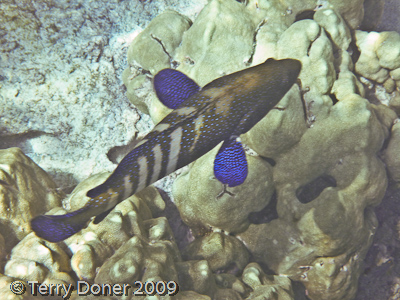
This beautiful fish was spotted in Honaunau Bay, which is just north of the place of refuge. I have not been able to determine what kind of fish it is; it is not listed in the field guide I purchased to help with species identification. So for now I will call him (or her) George. If anybody knows what kind of fish George is, please make a comment.

I am not a naturalist by formal training, but I do try to learn something about the biology or geology of the things I photograph. Not only does it add to my enjoyment, but it helps make for better pictures. Particularly for wildlife, if you know their behaviour and habits, you will be better able to create opportunities to capture the images you want.

1/125 f/5.9 ISO 200 @ 22.8 mm DMC-TS1

1/125 f/5.9 ISO 160 @ 22.8 mm DMC-TS1

Honaunau Bay, Hawaii

Wednesday, August 05, 2009

Are You Looking at Me?

We spent several hours looking for and observing the Green Sea Turtles during our time in Hawaii. The Hawaiian name is Honu. Although they seem clumsy on the ground, the are quite graceful in the water - except perhaps when they are feeding in shallow waters and the tail end sticks up exposed.

In Hawaii there is a fine for harassing or touching these creatures as they are endangered. Needless to say I was quite distressed to observe a little boy who was allowed to hit one of these creatures with a stick before the nearby parent finally intervened. If you chance to encounter one of these creatures, please keep your distance.

1/500 f/5 ISO 400 EF70-200mm f/2.8L IS USM @ 80 mm Canon EOS 40D

Punaluu County Beach Park, Hawaii

Taking their pictures from the surface while there are swimming takes much patience as they can hold their breath for quite some time and are more interested in eating than they are posing.

There are several places where they come on to shore to sunbathe and that is a good photo opportunity. But keep you distance and use your telephoto, this is one case with zoom with your gear is better than zoom with your feet.

1/400 f/4 ISO 400 EF70-200mm f/2.8L IS USM @ 195 mm Canon EOS 40D

Pu'uhonua o Honaunau National Historical Park, Hawaii

A Circular Polarizer can help cut through the glare and see into the water.

1/200 f/3.2 ISO 400 EF70-200mm f/2.8L IS USM @ 190 mm Canon EOS 40D

Pu'uhonua o Honaunau National Historical Park, Hawaii

I have seen some beautiful underwater photos of them as well, but unfortunately I was not afforded such an encounter this time around.